🚀 New: TikTok Scraper API — Extract videos, comments & profile data in structured JSON

Add Your Heading Text Here

SearchAPI Alternatives in 2026

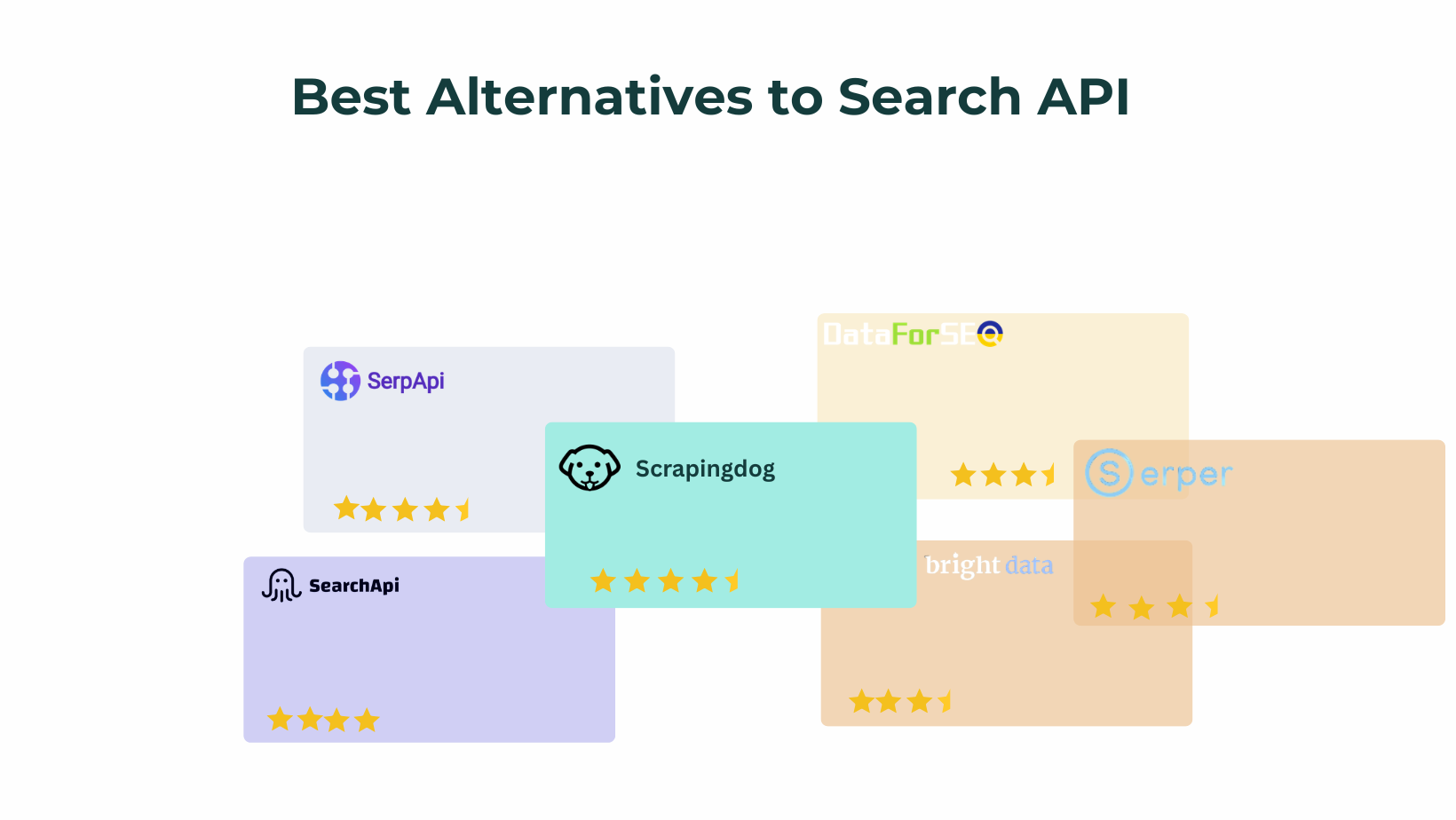
Best Alternatives to Search API

Table of Contents

SearchAPI.io, a developer focused SERP APIs infrastricture platform provides structured data to developers from majorly Google and other sources. It covers 50+ APIs, mainly focused on Google SERPs, and includes a $2M legal coverage clause, ZeroTrace privacy mode, and clean documentation. For a certain category of developers who need multi-search-engine coverage and legal protection for mass scraping, this can be a legitimate choice.

But still, there are specific conditions where SearchAPI falls short and can become a major issue when you move it into production:

The free tier is only available till 100 searches, and there is no pay-as-you-go model, causing credits to run out before even completing testing. The rate limit caps you at 20% of your monthly credits per hour, which means on burst workloads, you’ll hit throttling even when you have credits left. And at $2–4 per 1,000 searches, depending on your plan, the cost math gets uncomfortable once you’re running 100K+ queries a month. The cost decreases at scale, but it can still be higher than that of competitors.

We tested 7 of the strongest SearchAPI.io alternatives on price, speed, output richness, endpoint coverage, and flexibility. Here’s the complete breakdown.

Quick Comparison Table

Provider Cost / 1K Searches (Base Plan $1K) Avg Response Time (LITE Search) Avg Response Time (Advanced Search) Free Tier
Scrapingdog~$0.26~1.6s~2.7s1,000 credits
SearchAPI.io (baseline)~$1.7~1.6s~3.4s100 searches one-time
SerpAPI~$5.7~1.9s~4.8s100 searches/month
Serper.dev~$0.60~1sN/A2,500 searches
DataForSEO~$0.60~4–5 min async~4–5 min async$1 credit
Bright DataCustomN/AN/ATrial

What SearchAPI.io Actually Does Well

Before getting into why developers switch, let’s be clear about where SearchAPI.io genuinely earns its place:

2M$ Legal Coverage: SearchAPI offers a legal shield for collecting data from its APIs under US law applicable to customers worldwide. For enterprise teams, who scrape at scale and have concerns regarding the legality, you are already covered.

ZeroTrace mode: Setting zero_trace=true in any request prevents SearchAPI from logging or storing your request parameters, queries, or responses. For teams that don’t want someone to store their sensitive data, it is quite helpful.

50+ endpoints under one API key: Google Search, Google Maps, Google News, Google Shopping, Google Scholar, Google Jobs, Google Trends, Google Lens, Google Finance, Google Patents, YouTube, Amazon, Bing, Baidu, and more are all accessible through a consistent engine parameter in a single API schema. If you’re managing data from multiple search surfaces in one product, the unified schema reduces integration overhead.

99.9% SLA: SearchAPI guarantees uptime. For production systems where downtime has a direct business cost, this commitment matters.

Why Developers Look for SearchAPI.io Alternatives

Despite those strengths, three friction points come up consistently once teams move from evaluation to production:

1. The 100-Search Free Tier Is Not Enough to Evaluate

Most competing SERP APIs offer 1,000 (Scrapingdog) + PAYG, 2,500 (Serper), or 100/month ongoing (SerpAPI) free searches. SearchAPI only gives you 100 searches once. That’s not enough to test against your real query set, benchmark response quality across different geographies, or validate the output schema against your parsing logic. You’re essentially being pushed to pay $40 before you’ve properly evaluated the product.

2. The 20% Per-Hour Rate Limit Is a Real Constraint

The 20% cap on monthly credits per hour usage can cause a constraint in your workflow. There can be some moments where, for a short period of time, you may need a large burst to handle the API requests, but you will hit a ceiling before you exhaust your credits for a month.

3. Cost Gap Widens Dramatically at Scale

At 100K searches/month, SearchAPI.io costs approximately $200–400, depending on your plan tier. Scrapingdog at the same volume costs ~$25–35. That’s a 6–10x pricing gap for comparable Google SERP data quality. For projects where volume scales quickly, the compounding cost difference is significant.

What to Look for in a SearchAPI.io Alternative

Use this framework when evaluating your options:

  • Pricing model: Subscription vs. PAYG. Check the credit rollover policy and overage fees.
  • Rate limits: Per-hour, per-day, or concurrent request limits.
  • Endpoint coverage: Does it cover the search surfaces you actually need?
  • Response time: Measure at p50 and p95, not just median. Burst latency matters for real-time workflows.
  • Output richness: Does it cover featured snippets on Google like AI Overviews, People Also Ask, Knowledge Graph and much more?
  • Free tier: Can you properly evaluate it before paying?

1. Scrapingdog — Best Overall Alternative to SearchAPI.io

Starting price: 40$ for 40k Searches
Free tier: 1,000 credits on signup, no credit card required
Best for: Teams that want lower cost, broader Google coverage, and other search engine coverage.
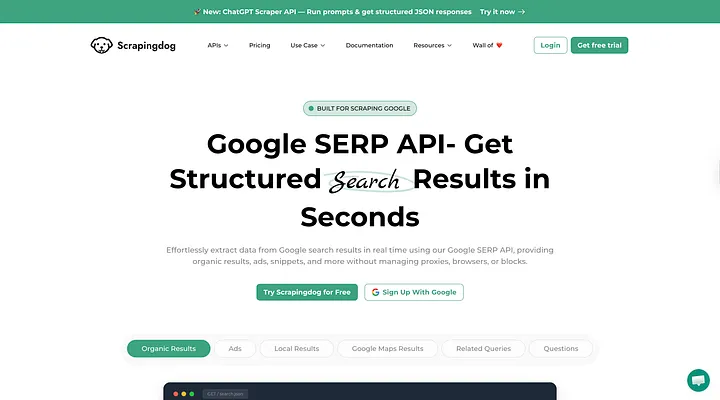
Scrapingdog google serp api

Scrapingdog’s Google SERP API is itself a powerful engine, powered by 25+ Google APIs, and is the most direct challenger to SearchAPI. The subscription can become 6–10x more economical at scale, with a credit rollover feature and no hourly rate caps, only a concurrency limit. Moreover, Scrapingdog also offers a pay-as-you-go system, allowing you to test the APIs thoroughly.

This doesn’t close the story. SERP is just one step in completing your data workflow, what if you need the content inside those links? That’s where the real game begins. Not all vendors in the market offer complete data coverage. With Scrapingdog’s powerful Web Scraping API, customers can directly scrape the content inside those links listed on SERP and complete their data workflow for research purposes.

Pricing comparison head-to-head:

Monthly Volume Scrapingdog SearchAPI Savings
10k~$10$404x
35k~$38$1002.5x
100k~$45$2505.5x
250k~$100$5005x

Performance (our test results):

  • For LITE Search:

    • Avg response time: 1.6sec, 2.4sec (p95)
    • Success rate on Google SERP: 100%

    For normal advanced search:

    • Avg response time: 2.7sec, 3.5sec (p95)
    • Success rate on Google SERP: 100%

Code example — migrating from SearchAPI.io to Scrapingdog:

				
					import requests

# SearchAPI.io (current code)
def search_searchapi(query, location="United States"):
    response = requests.get(
        "https://www.searchapi.io/api/v1/search",
        params={
            "engine": "google",
            "q": query,
            "location": location,
            "api_key": "YOUR_SEARCHAPI_KEY"
        }
    )
    return response.json()


# Scrapingdog (drop-in replacement)
def search_scrapingdog(query, country="us"):
    response = requests.get(
        "https://api.scrapingdog.com/google",
        params={
            "api_key": "YOUR_SCRAPINGDOG_KEY",
            "query": query,
            "results": 10,
            "country": country,
            "language": "en"
        }
    )
    return response.json()

// Node.js - SearchAPI.io to Scrapingdog migration

// SearchAPI.io (old)
const searchSearchAPI = async (query) => {
  const params = new URLSearchParams({
    engine: "google",
    q: query,
    api_key: process.env.SEARCHAPI_KEY
  });
  const res = await fetch(`https://www.searchapi.io/api/v1/search?${params}`);
  return res.json();
};
// Scrapingdog (new)
const searchScrapingdog = async (query) => {
  const params = new URLSearchParams({
    api_key: process.env.SCRAPINGDOG_KEY,
    query: query,
    results: 10,
    country: "us"
  });
  const res = await fetch(`https://api.scrapingdog.com/google?${params}`);
  return res.json();
};


Response schema mapping:

Both APIs return structured JSON. The field names differ slightly:

				
					SearchAPI.io field Scrapingdog field organic_results[] organic_data[] organic_results[].link organic_data[].link organic_results[].snippet organic_data[].snippet related_questions[] peopleAlsoAsk[] related_searches[] related_searches[] knowledge_graph knowledge_graph ai_overview ai_overview (dedicated endpoint)


Migration typically takes a minute; the schema is close enough that it’s a field rename exercise, not a rewrite.

Why choose Scrapingdog over SearchAPI.io:

  • 5x cheaper at comparable volumes
  • True PAYG, in which credits don’t expire — pay for what you use.
  • 10x more generous free tier, which covers web scraping and SERP APIs(1,000 credits vs. 100)
  • Faster responses from the API
  • A detailed output response coverin every inch of information from HTML.
  • Higher concurrency limit, allowing you to scrape even large number of results in a short period of time.

2. SerpAPI — Best for Maximum Engine Coverage

Starting price: $75/month for 5,000 searches ($15/1K)
Free tier: 100 searches/month (ongoing)
Best for: Teams that need 80+ search engines, the deepest feature set, and enterprise SLA
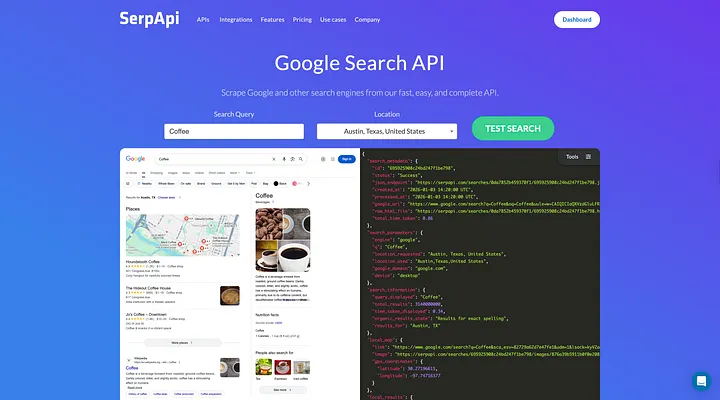
serpapi dasboard

SerpAPI is the most established player in the SERP industry, having operated since 2017. It is backed by a strong portfolio of 100+ APIs, double the number offered by SearchAPI on its platform. If your project requires an enterprise-level of scraping, maximum output richness, SerpAPI can be the best implementation.

Where SerpAPI is clearly ahead of SearchAPI.io:

  • 80+ search engine APIs vs. SearchAPI.io’s ~50 — including Naver, DuckDuckGo, Yahoo, and niche engines SearchAPI.io doesn’t cover
  • Ludicrous Speed mode — a premium low-latency option for real-time applications
  • More comprehensive output parsing — sitelinks, dates, video carousels, discussion threads, event results, and inline images are all covered by SearchAPI, but SerpAPI tries to get you the most out of the page. They consider every piece of information as an important data point.

The honest tradeoff:

SerpAPI is the most expensive option on this list by a significant margin, $15/1K at the Developer tier, $9/1K at the Big Data tier. For most teams, the 100+ engine coverage is more than they need, and they’re paying a premium for features they never use. SearchAPI.io already covers the search engines most projects actually need at roughly a third of the cost.

Pricing Breakdown:

Plan Searches/Month Cost Cost/1K
Starter1,000$25$25.00
Developer5,000$75$15.00
Production15,000$150$10.00
Big Data30,000$275$9.17

When to choose SerpAPI over SearchAPI.io:

  • You need multi-engine APIs.
  • You’re already integrated on SerpAPI’s SDK, and the migration cost exceeds the price premium
  • Budget is not a primary constraint

3. Serper.dev — Best for Speed + Budget at Google-Only Scale

Starting price: $50 for 50,000 searches (~$1/1K)
Free tier: 2,500 searches (most generous free tier on this list)
Best for: Google-only workflows at high volume where response time is critical
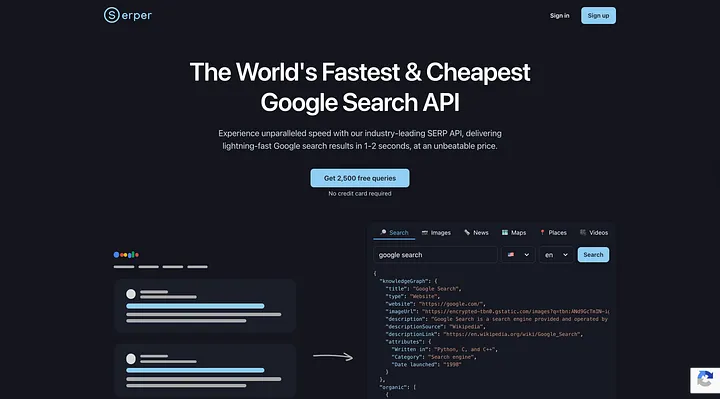
serperdev dashboard

Serper.dev is the fastest option on this list, with an average response time of nearly 1 second, driven by a lightweight architecture optimised for a single search engine. If your use case is Google-only and latency is the primary metric, Serper is hard to beat.

However, it is worth noting that Serper only covers the Google LITE page, not the current normal one. It has only 12 APIs in its portfolio, which all target different pages of Google and not any other search engine. But the product is still worth its price.

Where Serper wins over SearchAPI.io:

  • Speed — consistently the fastest real-time SERP API in independent testing
  • Price — $1/1K is 2–4x cheaper than SearchAPI.io at equivalent tiers
  • Free tier — 2,500 searches vs. SearchAPI.io’s 100. You can properly evaluate Serper before paying
  • Simple pricing — flat rate, easy to predict

When to choose Serper.dev over SearchAPI.io:

  • You only need Google (no Bing, YouTube, or Amazon data)
  • Response time is the most important metric for your use case
  • You want the most generous free tier to evaluate before paying
  • Volume is high, and you need the best cost per search

4. DataForSEO — Best for Bulk SEO Workflows

Starting price: ~$60 per 100K searches (async queue)
Free tier: $1 credit
Best for: SEO agencies, rank trackers, and keyword intelligence platforms running bulk queries
dataforseo dashboard

DataForSEO operates on a fundamentally different model from SearchAPI.io and the other providers on this list. Rather than a synchronous request-response API (submit a query, get results in 2–5 seconds), DataForSEO uses a task queue system: you submit queries in batches and retrieve results when they’re ready, which can take sometime depending on the number of queries submitted.

The setup may sound like a downside for real-time applications. But it is not, for SEO firms running large keyword tracking, weekly site audits, async processing is what they need instead of real-time data, which helps them significantly drive the cost lower at scale.

Why DataForSEO costs less:

The async model lets DataForSEO optimise server utilisation across time zones, batching similar queries and avoiding redundant requests. The Standard Queue is the cheapest tier; the Live API (real-time) costs more but is still significantly cheaper than SearchAPI.io.

Pricing at scale comparison:

Monthly Volume DataForSEO (Standard) SearchAPI.io
100,000 queries$60$250
500,000 queries$300$900
1,000,000 queries$600$1,500

Beyond SERP — DataForSEO’s broader data platform:

DataForSEO isn’t just a SERP API. It also provides keyword difficulty scores, search volume data, backlink indexes, on-page SEO data, and SERP feature tracking. If you’re building an SEO product and need SERP data alongside keyword intelligence, DataForSEO is a one-stop shop that SearchAPI.io isn’t.

When to choose DataForSEO over SearchAPI.io:

  • Your workload is batch/async — not real-time
  • Volume is high (100K+ queries/month), and cost is the primary constraint
  • You need keyword research and backlink data alongside SERP results
  • You’re building an SEO platform, not a real-time consumer application

5. Bright Data — Best Enterprise Data Platform

Starting price: Custom (contact sales)
Free tier: Trial only
Best for: Enterprise organisations with compliance requirements and global geo-targeting needs
brightdata dashboard

Bright Data is the biggest player in this whole web scraping market. They have a huge network of 150M+ IPs across 195 countries, which is the largest in the industry. And they have not sourced their IPs from any third-party provider, but they completely own their IPs, which gives them supreme flexibility in organising across their platform.

Bright Data can be expensive for small-to-medium scale enterprises, and the platform complexity makes the onboarding difficult. However, the super-large infrastructure makes their API super scalable in the market. It has various capabilities wrt to captcha solving technologies, browser fingerprinting, which most others can’t even match in the market.

What makes Bright Data genuinely different:

  • 150M+ IP coverage — residential, datacenter, ISP, and mobile IPs across 195 countries. For geo-specific SERP data (local SEO, country-specific search results), this is unmatched.
  • Compliance documentation — SOC 2, GDPR, and CCPA paperwork that enterprise procurement requires.
  • Dedicated account management — a real human who knows your workload.

When to choose Bright Data over SearchAPI.io:

  • Enterprise scale with compliance requirements
  • Geo-targeting at a granularity (city, ISP, carrier-level) that smaller providers can’t support
  • You need SERP as part of a broader web data strategy

Head-to-Head: Scrapingdog vs. SearchAPI.io

Since this is the comparison most readers are here for, here’s the detailed breakdown:

Dimension Scrapingdog SearchAPI.io
Cost at 100K searches/month~$45~$200
Cost at 10K searches/month~$4~$40
Free tier1,000 credits (no CC required)100 searches (one-time)
Credit modelPAYG and SubscriptionSubscription, monthly reset
Hourly rate limit❌ None✅ 20% of monthly credits/hour
Bing Search
Baidu Search
YouTube
Amazon
Legal coverage$2M
LangChain / n8n integration
99.9% SLA

The hourly rate limit in practice:

SearchAPI.io limits you to 20% of your monthly credits per hour. On the $40/month entry plan, that works out to roughly 800–1,000 searches per hour maximum. If your pipeline is bursty, a batch job that runs at 2am across 5,000 URLs before the business day starts — you’ll be throttled mid-run even with credits remaining. Scrapingdog has no hourly cap. You can burn 10,000 credits in an hour if your workload demands it.

Which Alternative Should You Choose?

All the providers mentioned in the list have one of the best web scraping services in the market. Scrapingdog and DataForSEO are known for a scalable API at low market prices, SerpAPI and BrightData are known for enterprise-scale volume, and Serper is known for its cheap and fast API in the market.
You should thoroughly test out all the vendors to be sure about the service, to know if the API would be a good value at scale. Factors such as concurrency, pricing, support and data coverage should be considered before taking a long-term decision.

Frequently Asked Question

Is there a free alternative to SearchAPI.io?

Yes, Scrapingdog provides you 100 free credits on registering on its platform without requiring a credit card. Serper and SerpAPI also offer a free tier with 2500 and 100 API calls, respectively. For genuinely free at higher volume, DataForSEO provides $1 in credit with no card required.

What is the cheapest SearchAPI.io alternative?

At 100K+ or 1M+ search volumes, Scrapingdog stands out as the most economical option among the competitors, providing services at a cost roughly 5x cheaper than SearchAPI at comparable volumes. DataForSEO’s Standard Queue is cheaper still for async/batch workloads that don’t need real-time results.

Does Scrapingdog cover the same endpoints as SearchAPI.io?

Scrapingdog covers 25+ APIs of Google, and has a total portfolio of 70+ APIs on its platform. It covers all the APIs offered by SearchAPI, including Google, Bing, YouTube, and Amazon, with a powerful General web scraping API that allows you to complete your data workflow and get all the information from a single platform.

Conclusion

SearchAPI is a great product and a highly scalable SERP API, backed by genuine strengths such as a 99.9% SLA, ZeroTrace mode, and 35+ APIs, which earn it a strong place in the market.

However, for the majority of developers, it is quite expensive compared to competitors offering the same or even better quality services. Plus, the 20% per-hour cap adds operational friction that other providers do not have.

Scrapingdog offers the best combination of pricing, Google endpoint breadth, PAYG flexibility, and a free tier large enough to properly evaluate the service before spending anything.

For developers and enterprises reading this article, Scrapingdog provides great flexibility while also being far more economical at scale, maintaining a 100% success rate with unmatched speed in the market. Additionally, the wide range of APIs covered by Scrapingdog gives customers the advantage of accessing all their data through a single platform.

Test it free with 1,000 credits at scrapingdog.com. No credit card required!

Chief of Technology at Scrapingdog. Every new bug comes under my to-do list. Writing is not something I'm into, but I share my insights through the blogs I write. Coding is what I love to do. Happy to connect with you on my social handle!
Darshan Khandelwal
Darshan Khandelwal

Web Scraping with Scrapingdog

Scrape the web without the hassle of getting blocked

Recent Blogs

Scraping Google Search Results with Node.js

Scraping Google Search Results with Node.js

Learn how to scrape Google Search results with Node.js using practical code examples, parsing steps, and a simpler API based approach for reliable SERP data.
Best Alternatives to Search API

SearchAPI Alternatives in 2026

Looking for the best alternatives to Serper API? Compare top SERP APIs by pricing, features, response time, AI Overview support, and free credits to find the right fit.