TL;DR
- The top Google SERP APIs in 2026, evaluated by speed, scalability, and pricing, include:
- Scrapingdog – Best overall SERP API with the fastest response time (1.83s), high scalability, and low cost at scale.
- Serper – Performance-focused API with low latency (2.87s) and competitive pricing for high-volume use.
- SearchAPI – Reliable, developer-friendly option with consistent results for production workloads.
- Bright Data – Enterprise-grade solution with massive infrastructure, best for large organizations.
- SerpAPI – Mature, feature-rich API with broad Google product coverage.
- Hasdata – Budget-friendly option with decent speed but limited high-concurrency reliability.
- Decodo (Smartproxy) – Proxy-powered SERP API offering strong IP infrastructure and solid scalability.
- Apify – Flexible actor-based platform, better for custom workflows than raw SERP speed.
- DataForSEO – SEO-focused API optimized for rank tracking and keyword intelligence.
- ScraperAPI – Easy to integrate but slower, making it less suitable for large-scale SERP scraping.
Search engines hold a massive amount of data, just to be specific in number there are around 8.5 billion searches per day, and Google alone caters it.
Scraping Google or any other search engine is worth considering if you need the data for SEO tools, lead generation, and price monitoring.
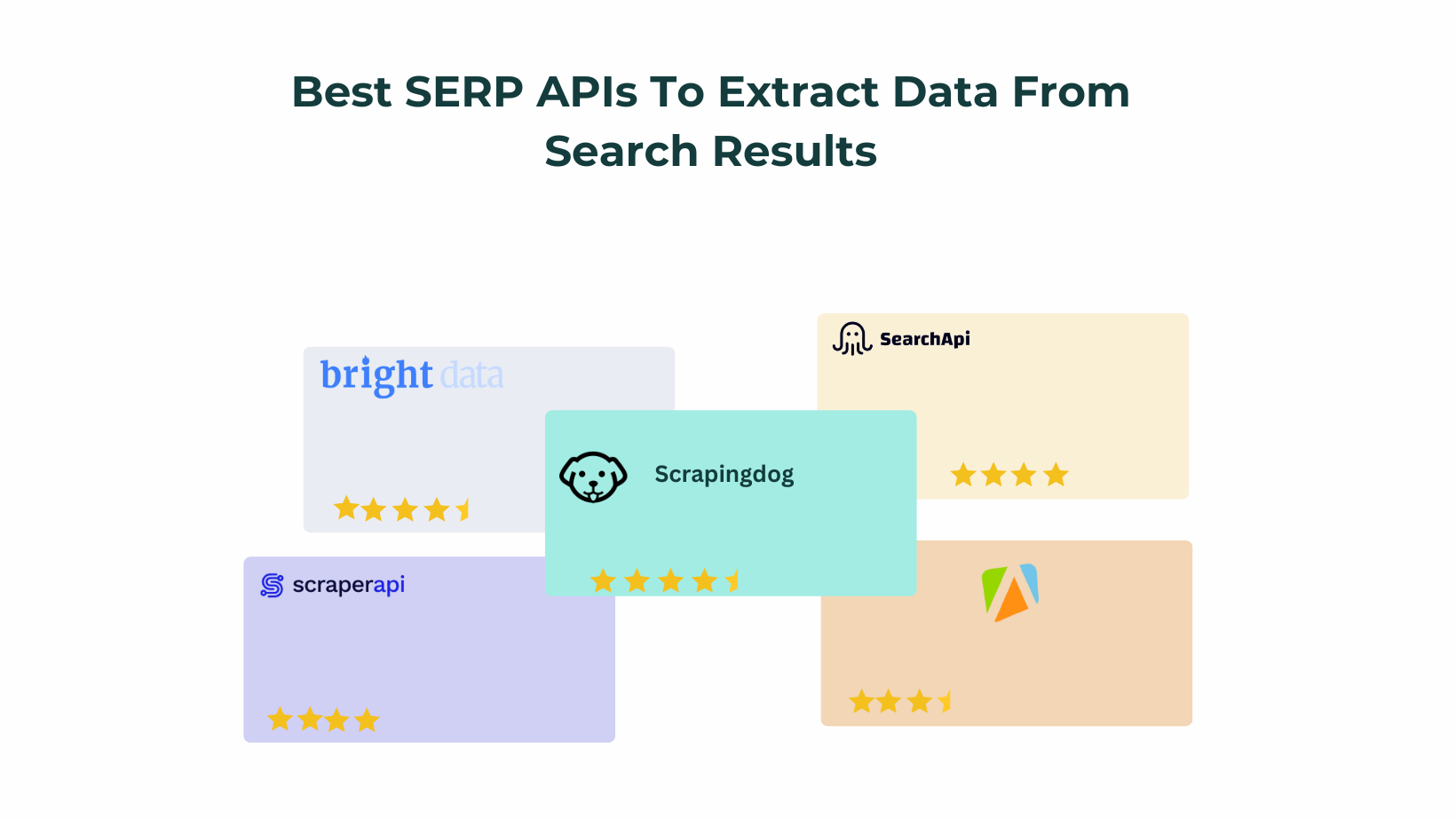
I’ve analyzed the best SERP APIs that deserve to be on this list. Each API has been tested on key factors like speed, scalability, and pricing.
I’ve shared my results at the very end of this article.
Let’s get started!! Before diving into the list, let’s quickly understand what a SERP API actually is.
What Is a SERP API?
A SERP API (Search Engine Results Page API) lets you collect search results from Google and other search engines programmatically, without dealing with browser automation, CAPTCHAs, or frequent blocks.
Instead of manually opening Google, copying results, or maintaining fragile scraping scripts, a SERP API returns structured data (usually JSON) in a single API call. This includes organic results, ads, featured snippets, local packs, and other SERP features ready to plug into your application or workflow.
What used to take hours of scraping logic, proxy rotation, and constant fixes can now be done reliably with a simple request.
Overview of popular SERP APIs
| Provider | Avg Response Time | Starting price subscriptions | Free Trial / Credits | Best For |
|---|---|---|---|---|
| Scrapingdog | 1.83s | $40 / month | 1,000 free credits | High-scale SERP scraping, SEO tools, rank tracking |
| Serper | 2.87s | $50 / month | 2,500 free queries | Fast Google SERP scraping |
| SearchAPI | 2.96s | $40 / month | 100 free requests | Reliable Google search extraction |
| Hasdata | 3.80s | $49 / month | 1,000 free calls | Mid-scale scraping workflows |
| Decodo (Smartproxy) | 4-5s | $20 / month | 1,000 requests | Proxy-backed Google scraping |
| Bright Data | 5.58s | $499 / month | $5 free credits | Enterprise-grade data collection |
| SerpAPI | 5.49s | $25 / month | 250 free searches / mo | Feature-rich Google APIs |
| Apify | 8.2s | $29 / month | $5 free credits | Scraping + automation workflows |
| ScraperAPI | 33.6s | $49 / month | 5,000 free credits | Teams/tools that don't need good response time |
| DataForSEO | N/A | Quotation based pricing | $1 free credits | Large SEO platforms |
10 Best SERP APIs for Scraping Google in 2026
We will be judging these APIs based on 5 attributes.
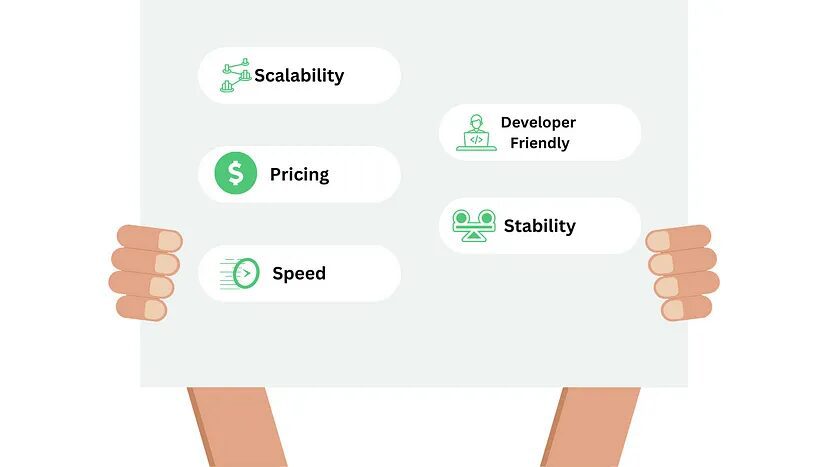
Key evaluation factors
- Scalability means how many pages you can scrape in a day.
- Pricing of the API. What is the cost of one API call?
- Speed means how fast an API can respond with results.
- Developer-friendly refers to the ease with which a software engineer can use the service.
- Stability refers to how much load a service can handle or for how long the service is in the market.
					import requests
import time
import random

# List of random words to use in the search query

search_terms_google = [
    "pizza", "burger", "sushi", "coffee", "tacos", "salad", "pasta", "steak",
    "sandwich", "noodles", "bbq", "dumplings", "shawarma", "falafel",
    "pancakes", "waffles", "curry", "soup", "kebab", "ramen"
  ];


# base_url = Your-API-URL

total_requests = 50
success_count = 0
total_time = 0

for i in range(total_requests):
    try:
        # Pick a random search term from the list
        search_term = random.choice(search_terms)
        url = base_url.format(query=search_term)

        start_time = time.time()  # Record the start time
        response = requests.get(url)
        end_time = time.time()  # Record the end time

        # Calculate the time taken for this request
        request_time = end_time - start_time
        total_time += request_time

        # Check if the request was successful (status code 200)
        if response.status_code == 200:
            success_count += 1
        print(f"Request {i+1} with search term '{search_term}' took {request_time:.2f} seconds, Status: {response.status_code}")

    except Exception as e:
        print(f"Request {i+1} with search term '{search_term}' failed due to {str(e)}")

# Calculate the average time taken per request
average_time = total_time / total_requests
success_rate = (success_count / total_requests) * 100

# Print the results
print(f"\nTotal Requests: {total_requests}")
print(f"Successful Requests: {success_count}")
print(f"Average Time per Request: {average_time:.2f} seconds")
print(f"Success Rate: {success_rate:.2f}%")
We will test the APIs with the above Python code.
Scrapingdog’s Google SERP API
Scrapingdog’s Google Search API provides raw and parsed data from Google search results.
Now, we might be biased for including our API on top (and yes, it’s what I get paid for — JK, I’m the CTO!). But honestly, all the APIs are tested, I have the results in the screenshots all through this article.
Details
- With this API you get more than a billion API requests every month which makes this API a healthy choice.
- Per API call cost for scraping Google starts from $0.003 and goes below $0.00125 for higher volumes.
- For testing the speed of the API we are going to test the API on POSTMAN.
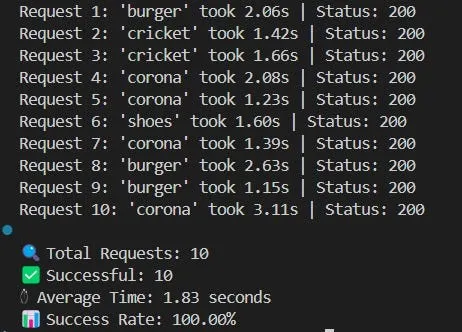
It took around 1.83 seconds to complete the request.
- Has documentation in multiple languages. From curl to Java, you will find a code snippet in almost every language.
- Scrapingdog has been in the market for more than 5 years now and you can see how customers have reviewed so far Scrapingdog on Trustpilot. The API is stable.
- You can even test the API for free, we provide 1000 free credits to spin it.
Here’s a quick video tutorial on how you can use Scrapingdog’s Google Search Scraper API.
Recently, we have introduced a new endpoint for scraping all major search engines via one call. We are calling it Universal Search API. If you are someone looking to get data from these engines, this API would fit in, wherein you get filtered results, so you don't have to omit repetitive results.
Further, using this API instead of calling each out would be a much more economical way.
Data For SEO
Data for SEO provides the data required for creating any SEO tool. They have APIs for backlinks, keywords, search results, etc.
Details
- Documentation is too noisy, which makes integration of the API time-consuming.
- The pricing is not clear. Their pricing changes based on the speed you want. But the high-speed pack will cost $0.002 per search. The minimum investment is $2k per month.
- They have been into scraping for so long and hence they have optimized it for scalability and stability.
- Cannot comment on the speed as we were unable to test the API because of the very confusing documentation.
Apify
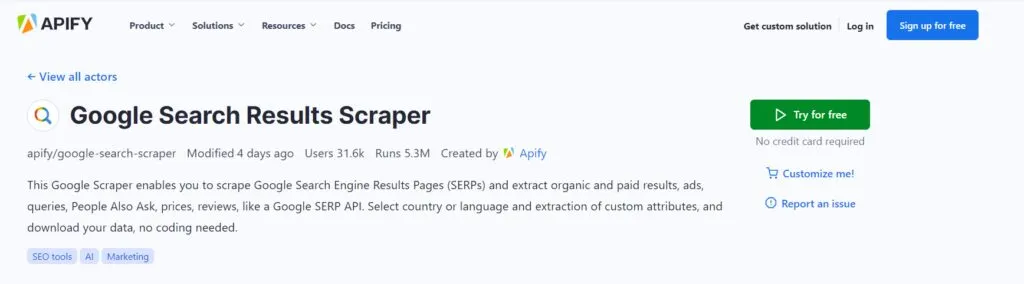
Apify is a web scraping and automation platform that provides tools and infrastructure to simplify data extraction, web automation, and data processing tasks. It allows developers to easily build and run web scrapers, crawlers, and other automation workflows without having to worry about infrastructure management.
Details
- The documentation is pretty clear and makes integration simple.
- The average response time was around 8.2 seconds.
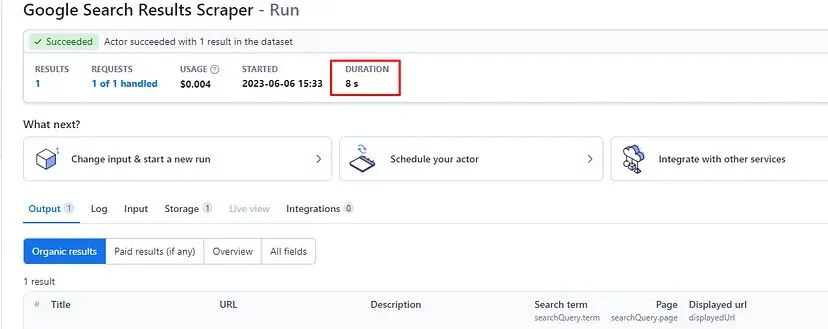
- Pricing starts from $0.003 per search and goes below $0.0019 per search in their Business packs.
- They have been in this industry for a very long time, which indicates they are reliable and scalable.
SearchAPI
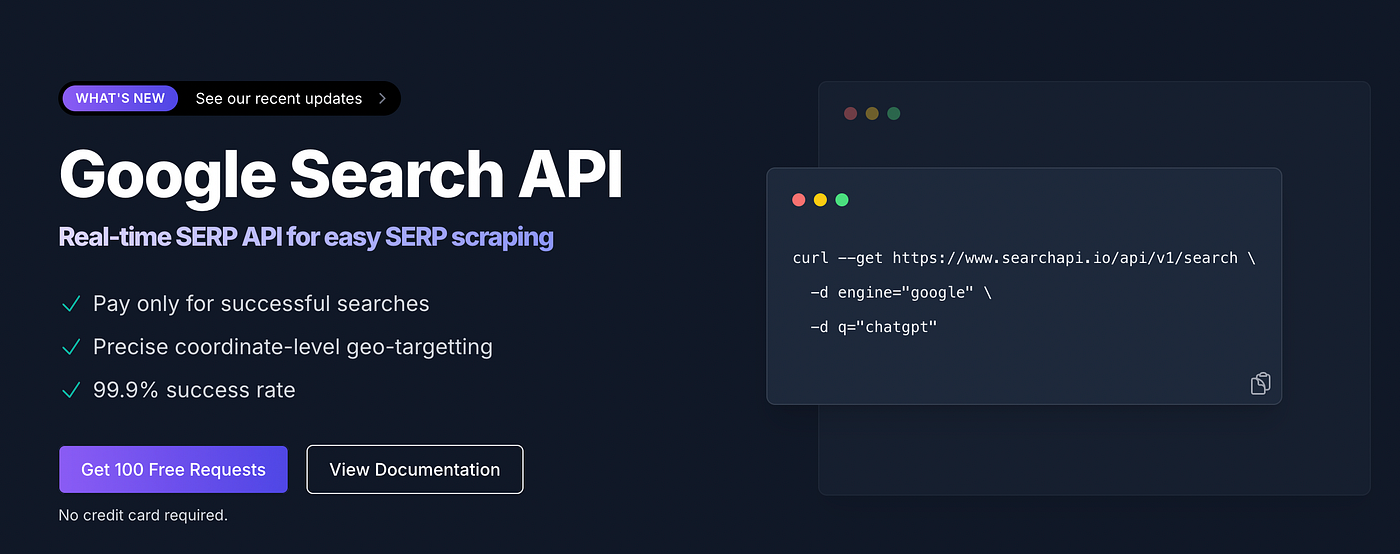
SearchAPI is another popular option among developers to scrape Google search results at scale.
This product has been there for a while now and its worth mentioning it in the list for the same reason it performed well in our test.
Details
- When you sign up, you get 100 free credits to test the API.
- Documentation is clear, and the API can be easily integrated into any environment.
- Pricing per page starts from $0.004 and drops below $0.002.
Testing
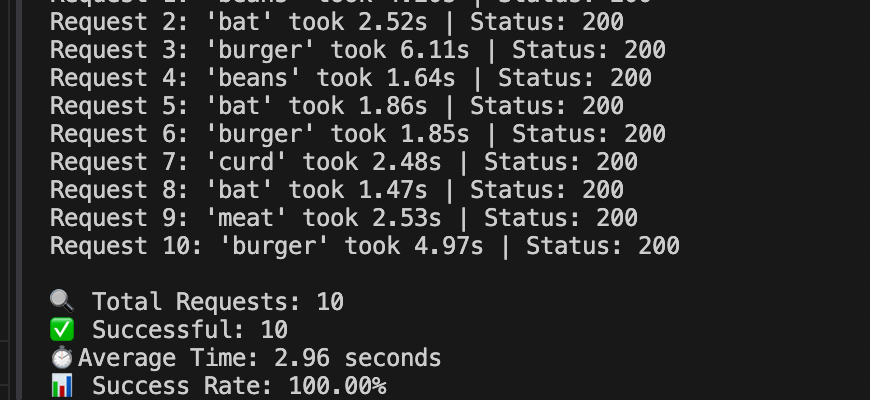
- We got 100% success rate with an average response time of 2.96 seconds.
Bright Data
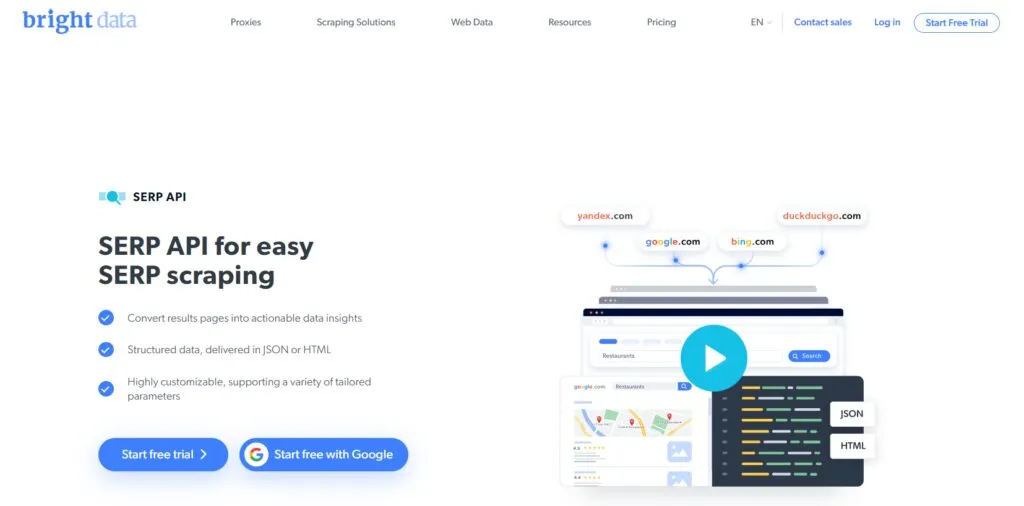
Bright Data as we all know is a huge company focused on data collection. They provide proxies, data scrapers, etc.
Details
- Their documentation is quite clear and testing is super simple.
- We tested their API, and the average response time was close to 5.58 seconds, which is good.
- Per API call cost starts from $0.005. The success rate is pretty great, which makes this API scalable and stable. The service is top-notch and again, any product you use is good.
- The only downside with Brightdata is that it’s a bit more expensive compared to other providers.
Hasdata
Hasdata is another great option if you are looking for a search engine API. Their dashboard makes your onboarding training pretty simple.
Details
- Documentation is pretty simple and easy to understand.
- Per API call response time is around 3.80 seconds.
- In my testing, I observed that APIs slow down if you hit the same API multiple times, which the API would not perform well when chosen for scalability.
- Per API call price starts from $0.003 and goes around $0.0004 with higher volumes.
Serper
Serper provides a dedicated solution for scraping all the Google products.
Details
- The documentation is clear, and the API can be integrated with ease.
- It’s a new service, and the people behind it don’t seem to have much public presence.
- Pricing per scrape starts from $0.001 and drops below $0.00075 with high volume.
- If you need more than 10 results per query in its SERP API, then you will be charged 2 credits, so the pricing automatically doubles.
- You can only contact them through email.
Testing
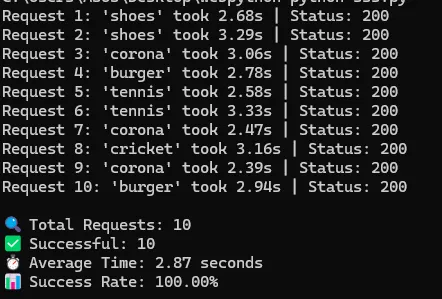
- So, the API took around
2.87seconds to scrape a single Google page.
SerpAPI
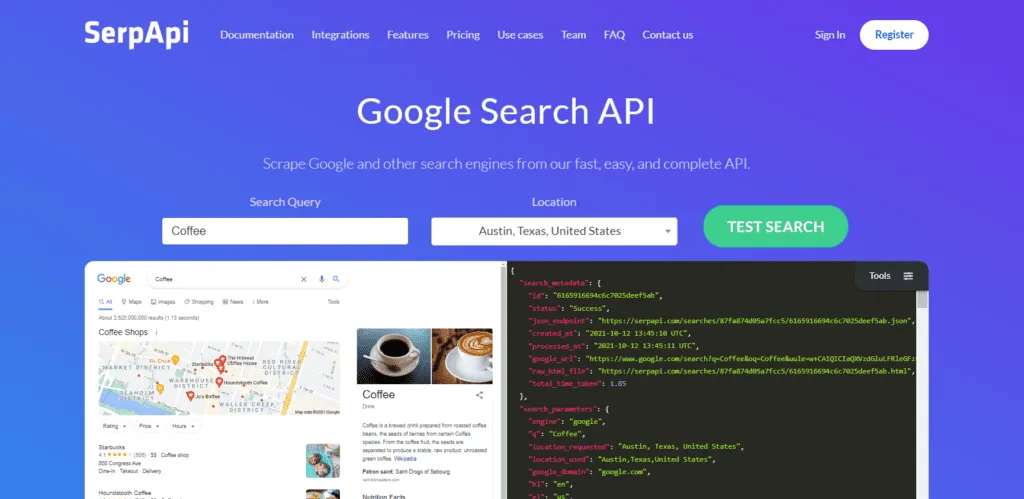
SerpAPI is the fastest Google search scraper API with the highest variety of Google-related APIs.
Details
- The documentation is very clear and concise. You can quickly start scraping and Google service within minutes.
- The average response time was around 5.49 seconds. API is fast and reliable. This API can be used for any commercial purpose which requires a high volume of scraping.
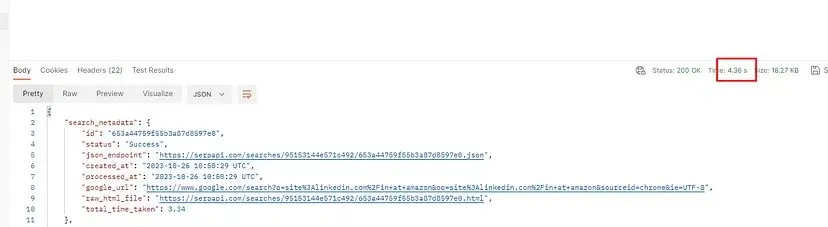
- Pricing starts at $0.01 per request and it goes down to $0.0083!
- SerpAPI has been in this industry since 2016 and they have immense experience in this market. If you have a high-volume project then you can consider them.
Decodo(Smartproxy)
Decodo is another Google search API provider in this list.
Details
- Documentation is simple. Integration with them is super simple.
- They have a great proxy infrastructure, which ultimately assures a seamless data pipeline.
- Pricing for Google scraping starts from $0.00125 and drops below $0.00095 with high volume.
- You can contact them via chat or email.
- It was not possible to test their API in our environment, so we tested it on the dashboard itself. So, their API took around
4to5seconds to scrape a single Google Page.
ScraperAPI
ScraperAPI was initially launched as a free web scraping API but now it also offers multiple dedicated APIs around Google and its other services like SERP, News, Jobs, Shopping, etc.
Details
- Documentation is very clear and has code snippets for all major languages like Java, NodeJS, etc. This makes testing this API super easy.
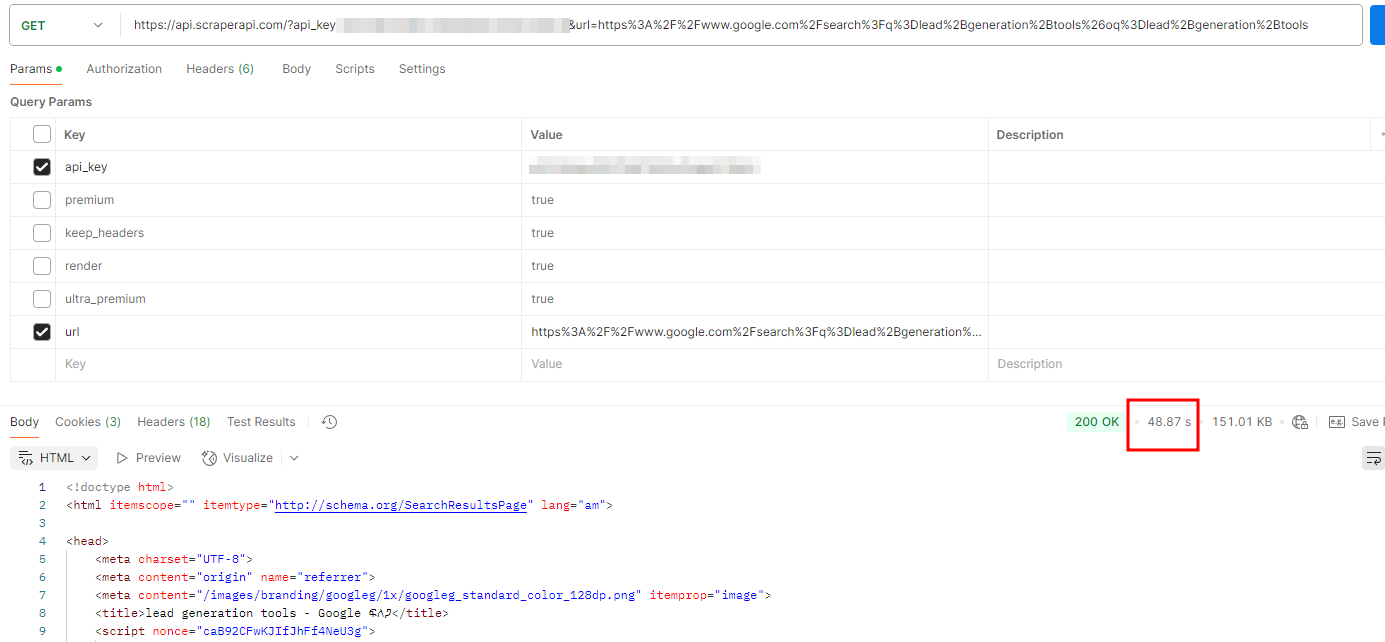
- The average response time was around 33.6 seconds, and it might go up for high concurrency.
- Pricing starts from 0.00196$ per search and goes up to $0.0024 for bigger packs.
- They have been in the market for a long time but the SERP API doesn’t meet the expectations.
Overall Results
| Provider | Response Time (s) | Pricing ($ per request) |
|---|---|---|
| Scrapingdog | 1.83 | 0.001 → 0.00029 |
| Serper | 2.87 | 0.001 → 0.00075 |
| SearchAPI | 2.96 | 0.004 → 0.002 |
| Hasdata | 3.8 | 0.00245 → 0.00083 |
| Decodo | 4.5 | 0.00125 → 0.00095 |
| Brightdata | 5.58 | 0.0011 |
| SerpAPI | 5.49 | 0.015 → 0.0075 |
| Apify | 8.0 | 0.003 → 0.0019 |
| ScraperAPI | 33.6 | 0.00196 → 0.0024 |
| Dataforseo | N/A | 0.002 |
At first glance, many of the APIs we’ve discussed may appear quite similar. But once you dig deeper and start testing, you’ll notice that only a few (specifically two or three) are truly stable and suitable for production use.
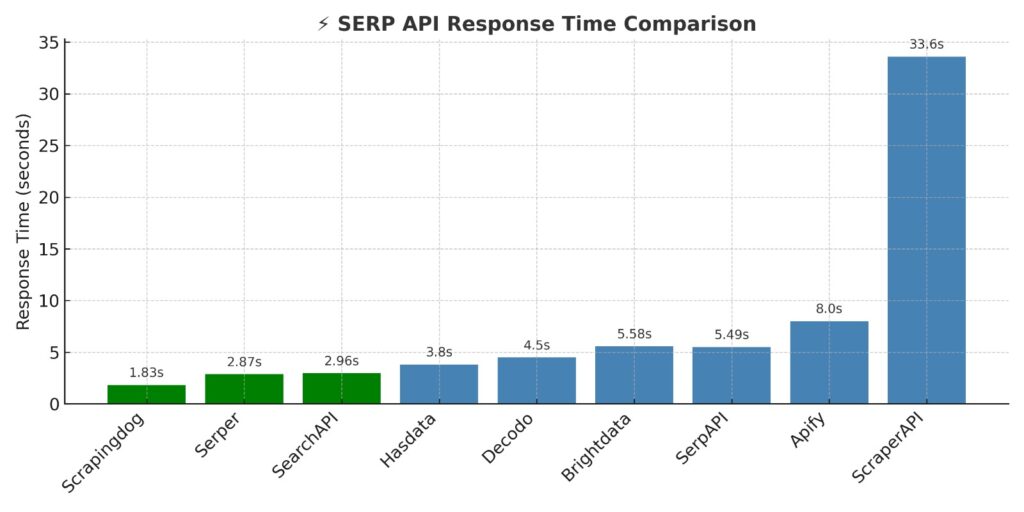
🚀 Conclusion: Serper, Scrapingdog & SearchAPI are the fastest, while ScraperAPI is the slowest among the tested services
The report above is based on a thorough analysis of each API, focusing on factors like speed, scalability, and pricing.
Almost all the APIs mentioned here offer free trials, so you can test them yourself firsthand and see which one fits your needs best.
Price Comparison
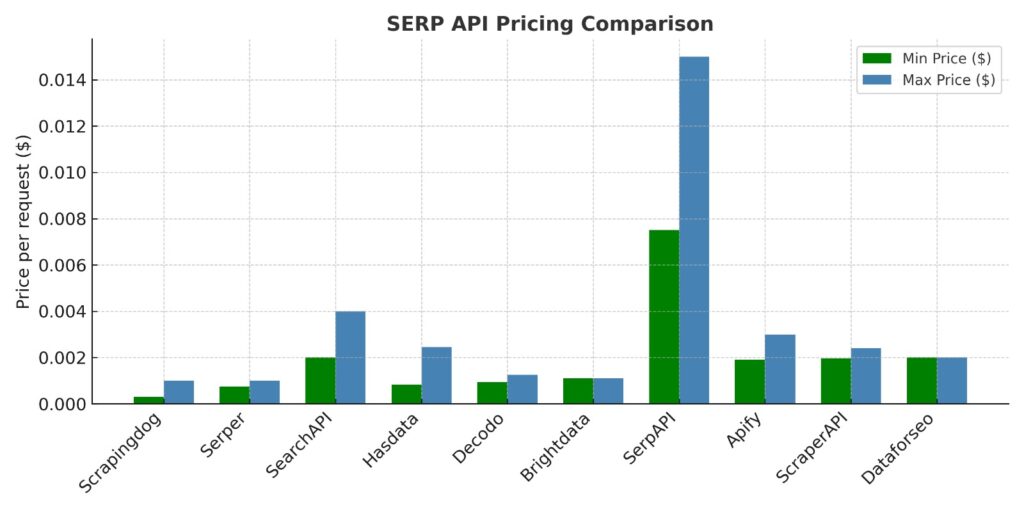
Scrapingdog offers the lowest effective pricing, dropping to $0.00029 per request at scale, far cheaper than competitors like SerpAPI ($0.015) or Apify ($0.003). Most other providers range between $0.0008 and $0.002 per request.
Why You Should Choose A SERP API Instead of Building Your Own Scraper
While you could build your scraper to extract Google search results, maintaining them over time can be quite challenging.
Search engines, including Google, often block scrapers after approximately 100 requests, making it difficult to scale without hitting roadblocks.
You’d need to constantly update your scraper to bypass these restrictions, which can be time-consuming and inefficient.
For production purposes, using an API is a much better option.
Here’s why:
Anonymity: With these APIs, you stay anonymous. Every request is made using a different IP address, so your IP is always hidden, preventing any blocks or restrictions from Google.
Cost-Effective: These APIs are far more affordable than Google’s official API. You can scrape search results at a fraction of the cost.
Parsed Data Options: Whether you need parsed JSON data for easy integration or raw HTML data for flexibility, these APIs offer both.
Customization: Many API vendors offer customization options to tailor the API exactly to your needs, making it easier to extract the exact data you want.
Reliability for Production: Unlike self-built scrapers that might get blocked or require constant maintenance, these APIs are designed to be stable, scalable, and perfect for production use.
24X7 Support: Round-the-clock support to help you solve any issues or queries, ensuring smooth operations.
What Data Other Then Google Search You Can Scrape From Google Products?
Search engine scraping is one of the most common ways to collect valuable data.
But search results aren’t the only data you can access. Other valuable sources can be scraped for more data. To name a few:
Scraping Google AI mode to keep track of your brand visibility, if SEO is one of the channels through which your brand acquires customers.
Scraping Google Maps opens up valuable opportunities to gather business details, reviews, and location data. This information is useful for local SEO, lead generation, and market analysis.
On the other hand, you can scrape Google News to do content analysis or monitor news coverage.
You can also collect data from other Google products, such as Google Scholar and Google Images.
I’ll continue to add more details and use cases for scraping these products as I write articles on them using Python.
Frequently Asked Questions (FAQs)
1. What is the best SERP API for SEO in 2026?
The best SERP API for SEO will still depend on your use case. However, our testing reveals that Scrapingdog provides a good value overall when you are looking to scale and need an economical API.
2. Is it legal to scrape Google search results using a SERP API?
It’s perfectly fine to scrape publicly available information. The tools mentioned here do the same; they only scrape public data at scale & can be used in your production.
3. Can these SERP APIs also be used in building a rank tracking system?
Yes, all of these APIs can be used to build a rank tracking system. We built a rank tracking system using Scrapingdog’s Google SERP API & n8n. Refer here if you think this would help.
4. Is it easy to integrate the Search APIs into my existing workflows?
Yes, all of the APIs mentioned above have good documentation. And they can be easily integrated into your existing tech stack.
Additional Resources
- How To Build Your Own Google Rank Tracking Mechanism using SERP API & n8n After num=100 Got Depreciated
- 3 Best Google Scholar APIs
- 5 Best Web Scraping APIs in 2026(Fast, Scalable & Easy To Use)
- 4 Best Twitter Scraper Scraping APIs You Should Try in 2026
- 4 Best New Screenshot APIs in 2026
- 4 Best Social Media Scraper APIs
- 4 Methods to Find All the URLs on a Domain
- 5 Best Google Maps Scraper APIs to Try Today
- 5 Best LinkedIn Scraping Tools (Ranked) by Scalability, Data Quality, and Pricing